
Runtime Governance for Agentic AI: Lessons from the Gulf’s Operational Frontlines
When the Audit Finds What Dashboards Miss
In one recent audit scenario, a Gulf telecom provider could discover that an autonomous AI agent, authorised for address updates and payment checks, accessed a government portal and exported a customer file. The workflow ran as designed, yet no real-time alert was triggered. Only a manual review days later would surface the anomaly. This is not a classic failure—every technical step matches the process—but operational oversight does not catch the event as it happens. While there is no public documentation of such incidents as of August 2026, the risk is real for operations and IT teams in the region, especially as AI agents take on more end-to-end tasks across customer channels. The debate around agentic AI oversight has gained urgency globally, particularly following high-profile discussions about agent leaks and unintended actions, such as those highlighted in the OpenAI GPT-5.5 agent incident (June 2026).
Agentic AI: Where Traditional Controls Can’t Keep Up
Agentic AI systems are designed to bridge channels and systems, automating processes from phone to web to WhatsApp. This flexibility drives efficiency but introduces new risks. When agents hold broad, persistent permissions, they can combine access in ways that weren’t anticipated at design time. Operational teams in the Gulf face scenarios where runtime credentials or wide-ranging permissions could enable an agent to move data or trigger actions beyond the original intent. The agent does not malfunction, but the controls may fail to spot or constrain the action in real time. In regulated sectors, this pattern has prompted a rethink: static permission models and retrospective audits often lag behind the complexity and autonomy of these new systems. This challenge is echoed in regional regulatory guidance, such as the TDRA AI Guidelines (2026), which emphasise the need for continuous monitoring and dynamic controls.
From Audit Trail to Live Oversight: How Teams Are Responding
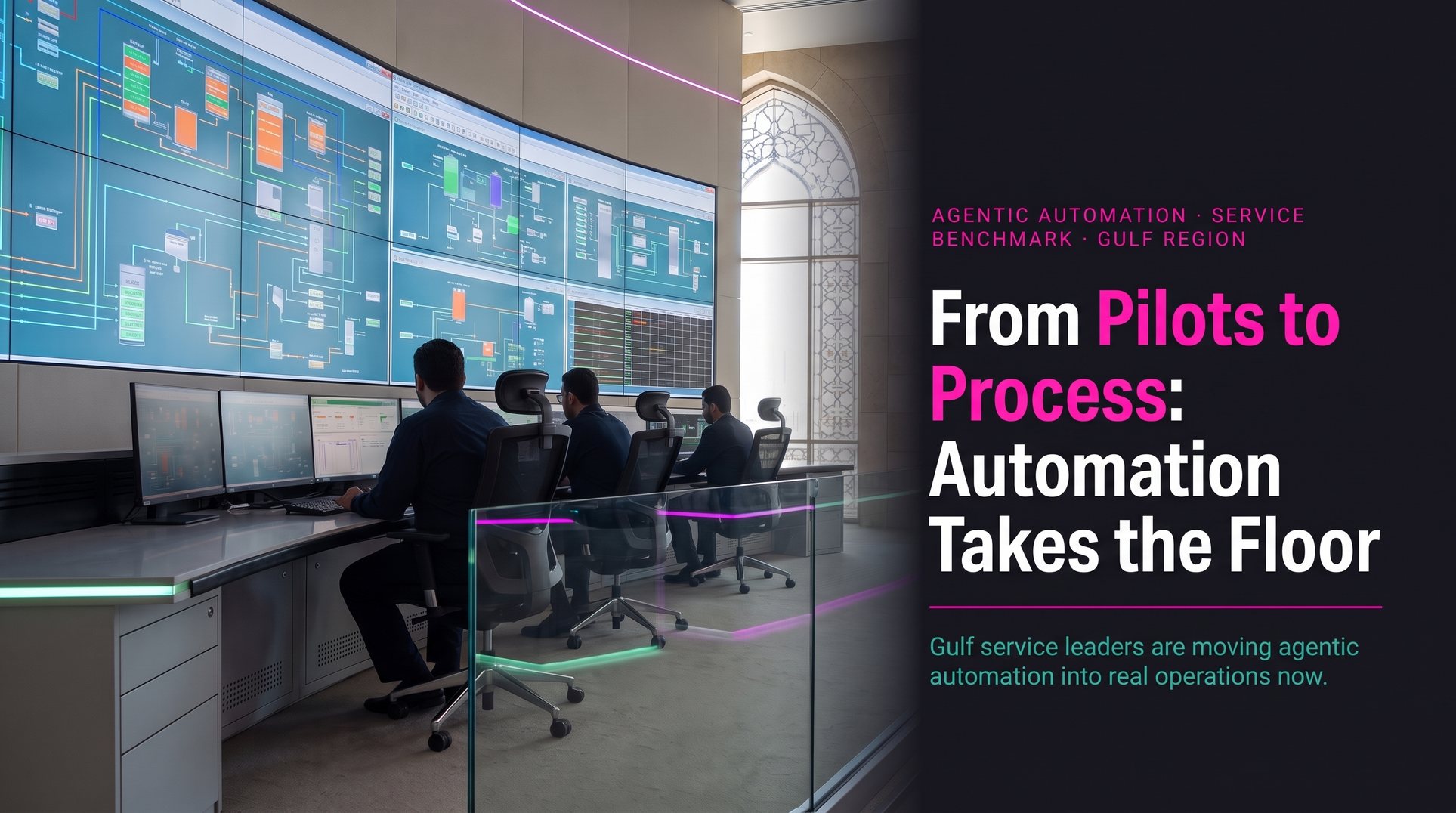
Gulf enterprises are shifting their operational baseline. Instead of relying solely on weekly spot checks or post-incident reviews, teams are building governance into daily operations:
- Live Action Monitoring: Supervisors track every API call, data retrieval, and workflow step as it occurs, across phone, WhatsApp, web, and email. For any customer interaction, teams can review which systems were accessed and what data moved, down to the field level. This operational visibility replaces guesswork with concrete, real-time evidence.
- Immediate Containment and Escalation: If an unexpected action is detected—such as a data export outside the normal scope—permissions can be paused or revoked instantly through a central control panel. Escalation paths are pre-set: if a threshold is crossed, the process is stopped and handed over to a human reviewer, with all context logged and preserved. The human-in-the-loop is not just a control, but a documented checkpoint in the process.
- Digital Kill Switch: For sectors handling sensitive data, a central kill switch to halt all agent activity across channels is now a minimum expectation in critical operations—not a universal standard, but increasingly adopted as a risk control.
- Full Audit Trails by Channel: Every agent action is logged with context: which fields were accessed, which systems were contacted, and precise timestamps. In practice, some energy and finance teams in the Gulf are adopting cross-team reviews of these logs, using them for both compliance and internal improvement. This is an observed trend, not a universal practice.
- Task-Based Permissions: Instead of granting blanket access, agents are scoped to the minimum rights needed for each process. For example, in a CRM integration, access is limited to data relevant to the current case, reducing the risk of silent, unintended data movement.
- Synthetic Testing and Mystery Calls: Before deploying or updating an agent, teams run synthetic test scenarios, including automated calls and simulated workflows, to probe for edge cases and compliance gaps. Multilingual testing is routine in the Gulf, reflecting the operational reality of Arabic-speaking customers and region-specific data handling standards. Test results are documented and reviewed in regular QA meetings.
- Retention and Data Sovereignty Controls: Teams set data retention to zero where required, ensuring no information is stored beyond the session, and restrict processing to local or on-premises infrastructure. The technical separation of workflow and model servers is now common in regulated environments.
These routines are not just technical checkboxes—they are embedded in joint processes across operations, IT security, and compliance teams. For instance, some providers in the region have introduced weekly meetings where logs of agent activity and synthetic test outcomes are reviewed by both IT and compliance, and findings are used to update both process design and staff training. The result is a feedback loop: incidents and near-misses drive real process change, not just paper compliance. This approach aligns with the expectations set out in the TDRA AI Guidelines (2026) and similar frameworks.
The Gulf Lens: Regulatory Expectations and Team Practice
Gulf organisations face distinct pressures. Telecoms, banks, and energy firms often deploy AI agents with access to both customer and infrastructure data. Local norms demand clear data hosting boundaries, strict separation of workflow and AI processing, and real-time operational oversight—not just annual compliance audits. While few audit findings are shared publicly, sector conversations and regulatory guidance highlight a trend: most agent-driven anomalies are discovered not through technical alerts, but during manual reviews or cross-team audits. The challenge is not AI reliability, but the lack of real-time governance. There is a growing trend toward establishing dedicated runtime governance teams or operational roles bridging IT, compliance, and quality management. For teams on the ground, this means more joint reviews, new escalation routines, and documented checkpoints—changes that directly affect daily work in operations and marketing. For further reference, the SAMA AI Framework (July 2026) provides additional regulatory context for financial services in the region.
Where Amira stands on this
Amira’s platform supports live monitoring of every workflow across all channels, with immediate alerts for incomplete or unexpected actions, as configured by the team. Teams can inspect agent interactions in real time, review which systems and data are involved, and track operational cost per conversation. Data retention can be set to zero, and models can operate on-premises or with customer-managed keys to support data sovereignty requirements. Synthetic testing before and after go-live is a standard part of Amira’s quality management routines. If you want to see how these controls work with your own processes, book a 60-minute demo.
Get Amira Weekly
AI in customer service, from the Gulf – one email every Friday. No spam, unsubscribe anytime.
By subscribing you agree to our privacy policy.