
Agentic Automation in SAP Procurement: Outcomes, Gaps, and Governance for Gulf Enterprises
When Automation Isn't Enough: The SAP Procurement Paradox
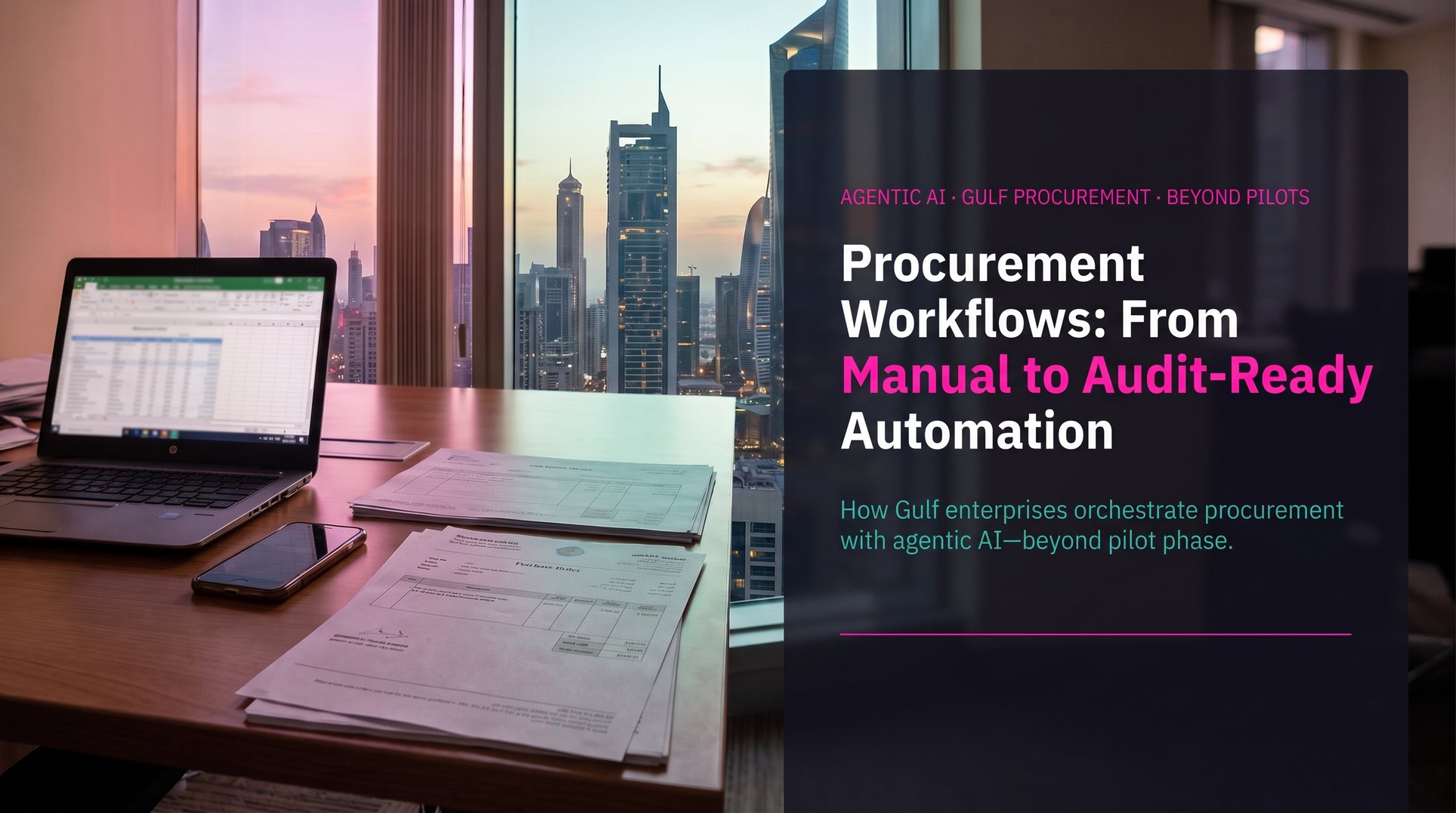
A procurement manager at a Gulf enterprise checks SAP for urgent purchase orders. The screen shows an order as approved, but the supplier hasn’t confirmed receipt. For example, staff may find themselves chasing missing invoices by e-mail, or a last-minute delivery change can be lost between ERP, procurement portal, and warehouse systems. Despite digital tools, the process breaks at handovers—manual entry, delayed approvals, and patchy visibility. The result: lost time, mounting costs, and compliance worries.
This isn’t a failure of automation itself. According to industry analysts, investment in agentic automation across Saudi Arabia and the UAE is at an all-time high, yet only 10% and 7% of procurement workflows, respectively, are fully automated end-to-end. The gap is not technical potential, but governance and trust. This article introduces the concept of the Governance-Ready Agentic Procurement Loop: a closed cycle where automation, auditability, and compliance are designed to reinforce each other, not compete.
Why the Governance-Ready Agentic Procurement Loop Changes the Game—And the Risk Profile
Unlike scripts or chatbots, agentic automation platforms in SAP procurement interpret triggers across channels, create and validate orders, manage exceptions, and adapt to process outcomes. As industry analysts outlines, these systems can handle ambiguity—like incomplete requests or mid-process changes—using context, not just rules. For Gulf enterprises, this means the agent can:
- Take an order via WhatsApp or e-mail, check it against inventory in real time, and submit it to SAP automatically
- Flag outliers or missing documentation for human review (not just error out)
- Log every step for auditability, enabling process owners to trace actions after the fact
However, as adoption accelerates, so do governance gaps. industry analysts note that most deployments still rely on manual oversight for critical handoffs due to concerns about process transparency, data flows, and regulatory exposure. In practice, the greatest challenge is not the automation itself, but ensuring its outputs are provable, auditable, and compliant. The Governance-Ready Agentic Procurement Loop is only achieved when every step, exception, and outcome can be traced and justified—by both humans and auditors.
What the Benchmarks Really Say: Outcomes and Their Limits
Vendor and industry sources report high headline numbers for cost savings or efficiency gains, but these are not independently audited. For example, industry analysts report invoice processing cost reductions of up to 78% in mature automation environments, and industry analysts say 89% of procurement professionals feel confident using AI to boost productivity. Still, these figures come from vendor and industry sources, not independent audits. As of August 2026, there appear to be no publicly available audited ROI or cost baselines from Gulf enterprises for agentic procurement automation. Direct comparisons to SAP-standard workflows or specific regional regulations are rarely available.
The measurable outcome that is publicly documented: end-to-end automation remains the exception, not the rule. As above, only a small minority of workflows in Saudi Arabia and the UAE are fully autonomous, despite heavy investment. The main barriers cited are data readiness, process documentation, and the need for auditable, human-in-the-loop controls. The Governance-Ready Agentic Procurement Loop remains an aspiration, not a regional norm.
Governance in Practice: What Needs to Be True for Auditability
For decision-makers, the question is not whether agentic automation is possible, but whether it is governable. A governance-ready deployment in SAP procurement should allow you to:
- Map every data flow, with clear documentation of data residency and retention (as required by local law)
- Enforce Bring Your Own Key (BYOK) models or on-premise hosting where needed, especially in regulated sectors
- Provide accessible, tamper-proof audit trails for every action taken by an AI agent
- Define escalation paths for exceptions, with human managers able to review, halt, or override AI decisions
- Test and document the agent’s behaviour before go-live—ideally including synthetic transaction runs under real conditions
As of now, most Gulf organisations are still building these controls. Data privacy and sovereignty requirements—such as the UAE’s PDPL—demand not just technical features, but operational discipline. The additional cost or effort for compliance depends on the extent of on-premise deployments, the complexity of data flows, and the maturity of internal audit teams. Benchmarks for these costs are not widely published; most enterprises appear to treat them as project-specific. Achieving a Governance-Ready Agentic Procurement Loop means closing these gaps before scaling further.
Where Amira Stands on This
Amira enables end-to-end process execution in SAP-driven procurement by connecting with existing systems and enforcing data boundaries such as Bring Your Own Key, on-premise hosting, and configurable retention. The platform provides per-process observability, audit trails, and escalation frameworks designed to meet the needs of regulated sectors in the Gulf. Amira deployments are designed to make automation steps transparent and reviewable by process owners and auditors. Which steps are missing from your own governance checklist—and how do you verify them before scaling further?
Get Amira Weekly
AI in customer service, from the Gulf – one email every Friday. No spam, unsubscribe anytime.
By subscribing you agree to our privacy policy.