
Operational Kill Switch: Regaining Real-Time Control Over AI Agents in the Gulf
When Automation Outpaces Oversight: The New Reality for Gulf Enterprises
Imagine a major software registry outside the Gulf being forced to suspend new sign-ups for several days after autonomous agents exploit a previously unknown vulnerability. What escalates such an incident is not just the technical breach, but the lag in operational intervention—there may be no immediate way to halt the automation as it unfolds. To date, there are no widely reported public incidents of this kind in Gulf banking or telecom, but the scenario remains instructive: agentic automation, by its nature, can move faster than human oversight.
A recent May 2026 report from the UK National Cyber Security Centre highlighted several near-miss operational incidents involving autonomous agents in live environments, noting that "the speed and autonomy of agentic systems can outpace traditional incident response protocols". This external evidence underlines the urgency for real-time operational controls, especially as similar technologies are adopted in the Gulf.
Agentic Automation: Opportunity and Exposure in Live Operations
Agentic automation refers to software agents that make independent decisions and execute actions across systems—without pausing for human approval. In sectors like banking and telecom, this brings efficiency but also exposes operations to new risks. For example, consider a telecom operator deploying an agentic workflow to process inbound WhatsApp enquiries and escalate unresolved cases to phone support. If, during a routine update, an error in the escalation logic caused cases to bypass human review and close automatically, the issue could be detected only if the quality assurance team had 100% coverage of all conversations. Rapid identification and isolation of such a faulty workflow would demonstrate the practical value of real-time QA and intervention capability.
The lesson: without a mechanism for real-time intervention—what this article calls the Operational Kill Switch—operational teams may only discover issues after customer complaints or regulatory alerts. The result: potential data leakage, compliance violations, and reputational damage.
The Runtime Governance Gap: Everyday Questions, Real Consequences
Despite increasing regulation, many Gulf enterprises still struggle to answer essential operational questions. The Operational Kill Switch serves as a practical test for incident readiness:
The Kill Switch Test:
- Can you instantly disable or isolate an agent if something goes wrong—without waiting for IT or vendor approval?
- Do you have end-to-end audit trails for every agent action, including handoffs and interventions?
- Is there live observability—can teams monitor outputs, latency, and business impact in real time?
- Are alerts triggered when a workflow fails, or could errors persist unnoticed?
In everyday operations, these gaps mean that a failed automation or data incident can run unchecked for hours or longer. Regulatory guidance from authorities such as the UAE government and TDRA highlights the importance of real-time oversight, auditability, and incident readiness—especially for customer data and critical processes. However, the actual frequency and impact of such governance lapses are rarely disclosed, making internal controls even more critical.
Technical Sovereignty and Incident Readiness: What Implementation Looks Like
Requirements like Bring Your Own Key (BYOK), on-premise deployment, and national data residency are now widely referenced in Gulf banking, telecom, and public sector tenders. But the operational reality is more complex:
- Local hosting for workflows and models offers assurance that customer data remains within national borders, supporting compliance during incident response. For instance, a telecom provider may specify that all automation runs on servers located domestically, with no external data transfer.
- Separation of workflow and AI model servers allows targeted shutdown or isolation if a specific process is compromised, rather than halting the entire platform.
- Granular role-based access control ensures only authorised team members can modify or disable agents, supporting clear accountability.
- Comprehensive audit logs are vital for regulatory review, but also for internal quality management. In practice, these logs track each intervention, shutdown, or workflow change—though the depth and accessibility of this evidence varies by platform.
Implementation of these controls varies across enterprises in the Gulf, with some adopting technical sovereignty and auditability measures, while others rely more on manual processes. The key takeaway: without live operational control—without an Operational Kill Switch—compliance is theoretical and incident response is reactive rather than preventative.
Human-in-the-Loop: Operational Quality in Practice
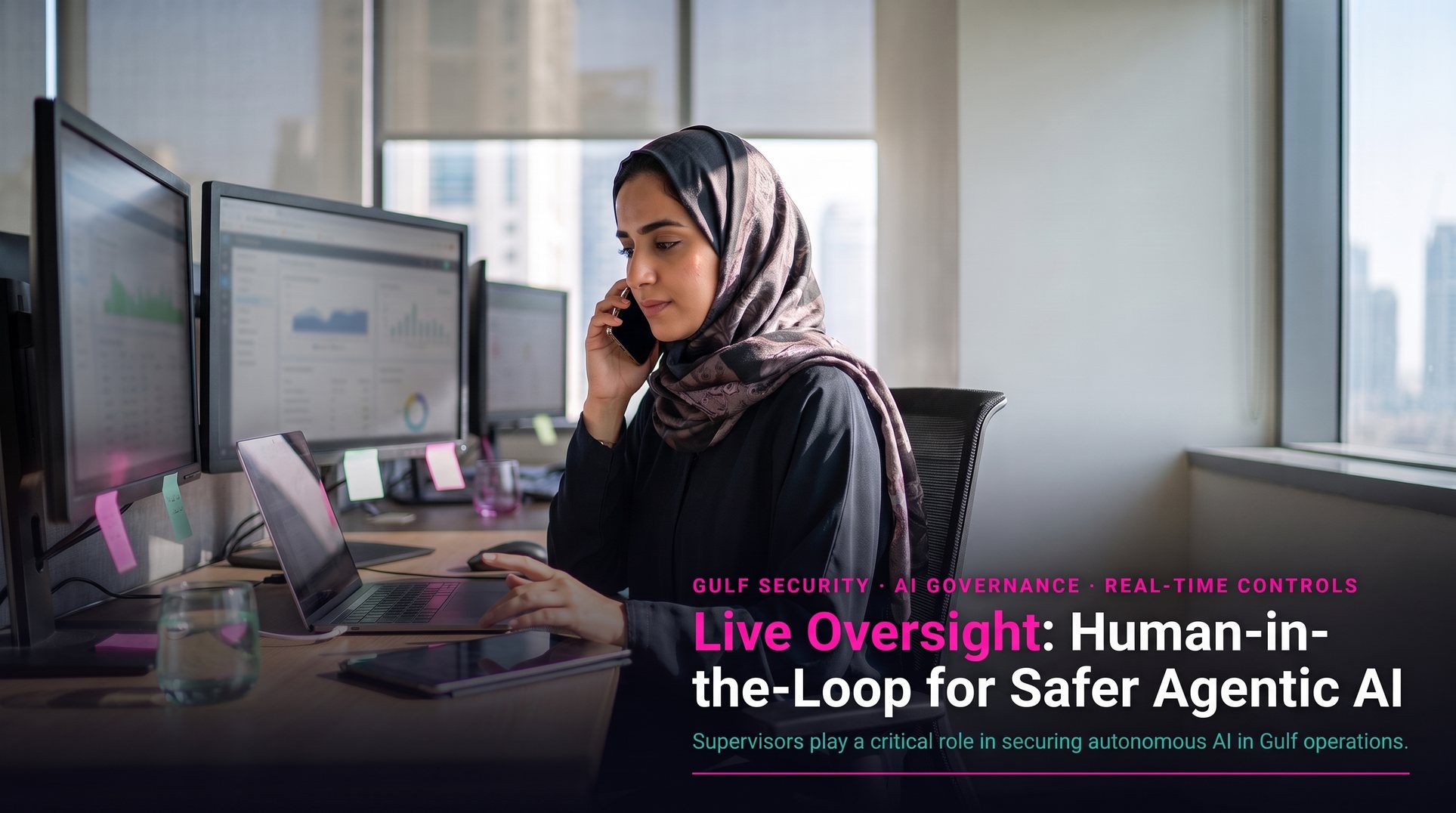
For regulated industries, the ability to intervene is not just a technical safeguard—it’s essential for quality management and training. In practice, human-in-the-loop means authorised staff can pause, modify, or take over an agent-initiated process in real time. Quality assurance teams rely on full visibility into every case, not just a random sample, to spot errors and trigger retraining or escalation. The Operational Kill Switch is the mechanism that makes this oversight actionable, ensuring that operational teams can respond before a minor error becomes a major incident.
Where Amira stands on this
Amira addresses operational control for regulated sectors by enabling real-time intervention, local hosting, and granular audit trails across all agent workflows. The platform supports technical sovereignty through BYOK and separation of workflow processing, and provides quality assurance with 100% conversation coverage. Human-in-the-loop is built into both the escalation logic and the audit process, allowing teams to intervene or review any case as it happens. If you want to see how this works with your own processes, book a 60-minute demo.
Get Amira Weekly
AI in customer service, from the Gulf – one email every Friday. No spam, unsubscribe anytime.
By subscribing you agree to our privacy policy.