
From Fragmented Tools to Orchestrated Workspaces: What the Unified AI Shift Means for Gulf Customer Service
Scene: Fragmented Onboarding in Gulf Customer Service
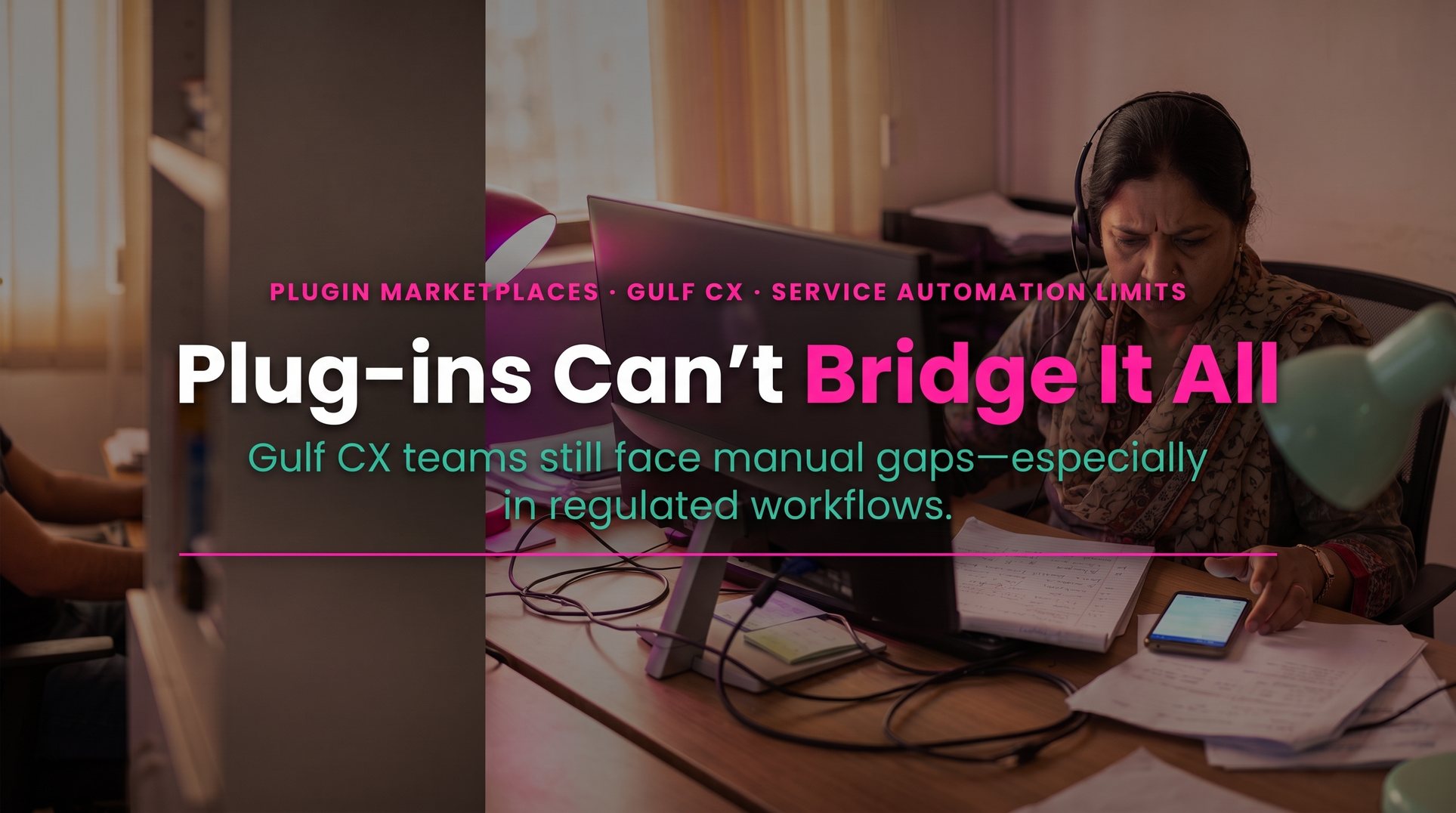
A new agent starts work in a Gulf contact centre. Their screen fills with browser tabs: scripts, tickets, onboarding folders, and a knowledge base—each in a different app. Every customer interaction means toggling between windows, copying details, and hoping nothing is lost, especially when switching between Arabic and English. Most onboarding depends on personal workarounds, with outcomes relying on memory and manual steps. In reality, the first week is spent learning where to find information, not how to resolve cases.
Now, this friction is facing a structural change. Unified AI workspaces—environments that combine chat, automation, and documentation—are beginning to replace patchwork toolsets. With new AI-driven platforms entering the market, Gulf customer service teams are being asked to rethink how they transfer knowledge, automate processes, and ensure reliability at scale. The Unified Workspace Shift is more than a new interface; it’s a new operational model that brings both opportunities and new questions.
Orchestrated Workspaces: What Actually Changes?
Unified AI workspaces aim to bring chat, automation, and documents into a single, orchestrated environment. Unlike traditional chatbots or document tools, these platforms are designed to handle multi-step business processes, keep context across channels, and interact with external systems. For example, new models can follow business logic, automate repetitive steps, and catch errors in real time—inside productivity suites or ticketing tools.
For Gulf organisations, the shift has specific implications:
- Onboarding: Instead of relying on static documents, new hires can be guided interactively, with AI summarising and adapting knowledge live. Some organisations outside the Gulf have reported faster ramp-up periods, but there are no public baseline figures for the Gulf as of August 2026.
- Multilingual Operations: Customer expectations span Arabic and English, with WhatsApp and telephony often used in parallel. Language switching is supported by many platforms, but the effectiveness depends on the specific deployment and is best validated in a live pilot. Language recognition errors or mid-conversation switching issues can still occur and need to be tested in context.
- Process Handover: Instead of losing context between chat, e-mail, and calls, orchestrated workspaces keep all steps, notes, and outcomes linked to the original case. In practice, this means agents can see not only recent chats but also the full process history and any open actions, reducing repeated questions and friction during handovers.
Operational Impact: Gains, Limits, and What Remains Unclear
Leaders in Gulf operations point to several benefits of unified AI workspaces, but there are important caveats:
- Onboarding Time: Where AI-driven onboarding replaces static reading, some sectors outside the Gulf report faster readiness for new hires. Some external sources suggest onboarding time can be reduced, but there are no region- or sector-specific benchmarks publicly documented for the Gulf as of August 2026.
- Quality Assurance: Moving from sample-based to full-coverage QA is now technically possible. Instead of reviewing a handful of interactions manually, systems can score every conversation against custom benchmarks. For instance, some platforms can predict NPS and CSAT per call. Amira’s internal calibration (94% NPS prediction accuracy, see context) has not been externally audited in the Gulf.
- Error Handling: The risk of silent process failures—such as a missed CRM update or incomplete ticket—drops when automations are monitored end-to-end. Some platforms provide detailed logs and phase-level timelines, while others offer only basic notifications. In regulated environments, transparent audit trails and role-based controls are critical, but detailed public examples for the Gulf are lacking.
Despite these gains, some issues remain unresolved:
- Integration Depth: Many Gulf enterprises still run custom CRMs or legacy ERP systems. While unified workspaces offer broad API connectivity, custom integrations may require project-specific development, depending on the systems in use. Regulated industries may need extra compliance checks and internal approvals. No public case studies from the region detail integration timelines or costs as of August 2026.
- Cost Transparency: Usage limits and pricing models are not always clear, especially with consumption-based AI platforms. This complicates budgeting for large-scale rollouts. Leaders should request clear cost breakdowns, baseline measurement offers, and contractual exit options before scaling.
- Regulatory Assurance: For quality managers in regulated sectors, auditability and documentation of automated processes are essential. Not all platforms provide detailed audit trails or granular access control. Where audit requirements include retention policies, anonymisation, or data sovereignty, teams should review technical documentation and test in a controlled setting first.
Integration and Multichannel Reality in the Gulf
Gulf organisations typically operate across WhatsApp, phone, web chat, and e-mail as standard channels. Switching between Arabic and English—both for customers and internal documentation—must happen smoothly. While many AI models now support these functions, the degree of accuracy and reliability is best validated in a real-world pilot. Market observations indicate a trend toward platforms capable of orchestrating both new and legacy systems, especially where sector-specific or locally hosted software is in use.
Integration remains a major challenge: off-the-shelf connectors rarely cover every in-house or regional system. In practice, teams often need to bridge gaps with custom APIs or manual steps. Full replacement of legacy infrastructure is rare; successful automation depends on platforms that can overlay and orchestrate what’s already in place, rather than rip and replace.
Three Priorities for Leaders: Orchestration, Quality, Integration
For Gulf CX and operations leaders, three priorities now stand out:
- End-to-End Orchestration: Effective automation means designing workflows that span multiple channels and systems, with the ability to monitor, adjust, and audit each step. Leaders should assess whether their workspace platform provides detailed visibility into every action, not just surface-level reporting.
- Quality Management at Scale: 100% interaction scoring is technically feasible, but it requires the right tooling and clear criteria. Teams should review how their platform documents scoring logic, enables calibration against human auditors, and supports targeted coaching. In regulated sectors, audit trails and anonymisation are essential.
- Integration and Scalability: Before scaling automation, leaders must map which legacy and SaaS systems need to be included—and test integrations in a controlled environment. Platforms that offer API-first designs and clear error-handling mechanisms reduce the risk of silent failures and support smoother rollouts.
A practical step: select a recent process—such as a WhatsApp-to-CRM case or a multi-language onboarding flow—and document how many tools, manual steps, and handovers are involved. This exercise reveals both the immediate gains of orchestration and the integration gaps that must still be addressed.
Where Amira Stands on This
Amira enables Gulf enterprises to orchestrate end-to-end workflows by connecting to existing telephony, CRM, and ERP systems via API, usually without requiring a full system replacement. Each process can be monitored from initiation to completion, with workflow failures triggering alerts for intervention. Quality assessment supports calibration against human scoring, and handovers between channels retain full process context. If you want to see how this works with your own processes, book a 60-minute demo.
Get Amira Weekly
AI in customer service, from the Gulf – one email every Friday. No spam, unsubscribe anytime.
By subscribing you agree to our privacy policy.